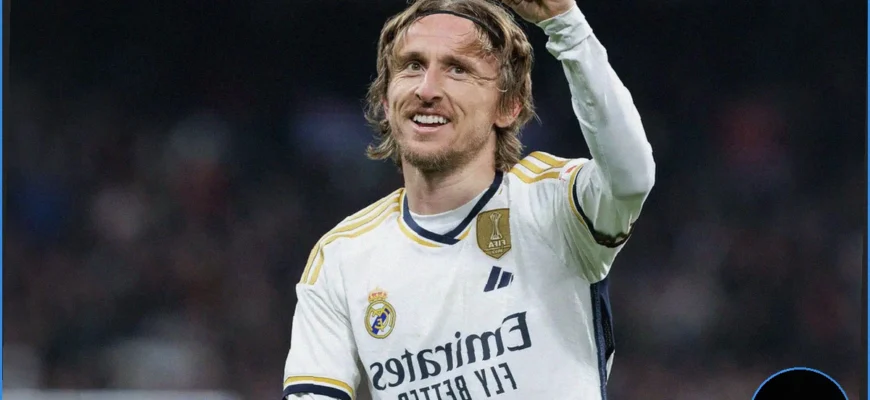
AC Milan’s summer has begun with a surge of questions, particularly concerning the immediate future of their influential midfielder, Luka Modrić.
The surprising dismissal of manager Max Allegri has cast a shadow of doubt over the club’s most pivotal player. Reports suggest that Modrić’s decision to remain with the Rossoneri was contingent on Allegri’s continued tenure, a condition that is now obsolete.
With the manager gone and Champions League football absent from next season’s schedule, Modrić’s presence at Milan is once again under serious question.
Luka Modrić: Milan’s Midfield Anchor
A celebrated figure in modern football, the 40-year-old Modrić is renowned for his transformative impact. His illustrious career at Real Madrid saw him become a cornerstone of a dominant team, securing five Champions League titles and setting new benchmarks for central midfielders.
His arrival at Milan on a free transfer last summer, on an initial one-year deal, was envisioned as a cornerstone of Allegri’s rebuilding project, signalling the club’s ambition to attract top talent.
Modrić exceeded expectations, featuring in 32 Serie A matches and playing more minutes than in his final five seasons at Madrid. He was Milan’s most consistent creative force in an otherwise challenging campaign. An injury to his cheekbone, sustained against Juventus, sidelined him for the final four league games, pushing his decision regarding his future into late May, a timing that now appears significantly ominous.
Reasons for Modrić’s Renewed Uncertainty
The unique structure of Modrić’s contract places the ultimate decision in his hands. His one-year extension clause requires his explicit consent, with AC Milan lacking the unilateral right to activate it.
This player-centric agreement means the club must await his decision before making any significant midfield recruitment moves. Prior to Allegri’s dismissal, it was believed Modrić was inclined to activate the extension, driven by a desire to conclude his career at the highest level of European football and compete in a final Champions League campaign.
However, both these motivating factors have been simultaneously eroded. The new managerial appointment is unknown, his rapport with the previous coaching staff is gone, and the Champions League aspirations have vanished with the team’s failure to secure a top-four finish.
The foundations supporting his potential renewal have crumbled within days, creating a critical juncture for the club.
The Impact of Modrić’s Potential Departure on Milan’s Midfield
Losing Modrić would mean more than just losing a player; it would mean losing the team’s standard-bearer. His presence provided structure, controlled the tempo, and served as a professional example for younger players navigating the demands of Serie A competition.
This crucial mentoring role is virtually irreplaceable in the transfer market. There had even been speculation about Modrić potentially transitioning into a coaching role at Milan, further integrating him into the club’s long-term vision.
That prospect now seems distant. Milan’s broader summer transfer plans, which include targets like Goretzka and Kim Min-jae, are already complex. Modrić’s departure would add an urgent need for midfield reinforcement to an already packed agenda.
Challenges: No European Football, No Allegri, No Simple Solution
The 2026 World Cup is a significant event on Modrić’s personal timeline, with Croatian and international reports consistently highlighting it as a key milestone. This suggests he would want to remain active at club level until at least that summer.
While this reasoning still holds, the question is whether Milan can offer the environment to justify it. His reported net salary of approximately €3.5 million remains an offer, but financial considerations were never the primary driver.
Without Champions League football and the manager who convinced him to join Milan, the proposition appears considerably less appealing than it did just two weeks ago.
Whether a new managerial appointment can alter this calculation remains an open question, and Milan may face a tight deadline to find an answer.
The Path Forward for Modrić and Milan
The timeframe for a decision is limited. Modrić was expected to announce his choice regarding his contract extension in late May or early June, a timeline that has not shifted despite the internal turmoil.
The identity of Allegri’s successor will be a crucial signal. The right appointment could reignite discussions, while an unfavorable choice might permanently close the door.
AC Milan is also navigating squad uncertainty elsewhere, with the future of Rafael Leão reportedly attracting interest from Barcelona, adding to the club’s current challenges.
One of Europe’s most storied clubs now awaits the decision of a 40-year-old player who holds all the leverage, as the football world watches to see his next move.