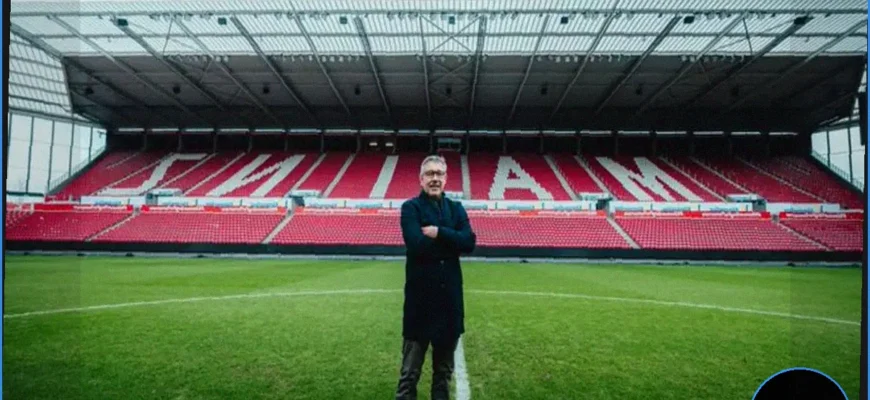
Urs Fischer, head coach of Mainz 05, has shed light on his remarkable achievement of transforming a bottom-of-the-league Bundesliga team into a formidable European contender. His Mainz side is not only progressing as a quarterfinalist in the Conference League but is also unexpectedly positioned to potentially secure a European spot through their league performance in the upcoming season.
When Fischer assumed command from the dismissed Bo Henriksen in early December, the club languished at the foot of the Bundesliga table with a mere six points. Following crucial draws against Bayern Munich and St. Pauli, which brought their tally to eight points before the winter pause, Fischer’s squad has accumulated an impressive 25 points in the current calendar year. This significant surge has propelled them dramatically up the standings, now occupying ninth place.
With 33 points and six fixtures remaining, Mainz 05 appears to have largely secured their Bundesliga survival. However, Fischer, a seasoned 60-year-old coach, maintains a more reserved stance, diverging from Steffen Baumgart, who coaches Fischer’s former club, Union Berlin. Baumgart expressed confidence that Union would avoid relegation with their 32 points after 28 matchdays. It’s worth noting that Fischer’s detailed interview preceded Mainz’s recent upset victory over Champions League hopefuls Hoffenheim, a result that further solidifies their position. Under Fischer, Mainz has now remarkably taken points from several top teams including Bayern, Bayer Leverkusen, RB Leipzig, Eintracht Frankfurt, and Hoffenheim since his arrival.
Urs Fischer’s Cautious Outlook: The Fight Continues
“I don’t yet view my time here as a complete success,” Fischer stated, acknowledging the positive results but emphasizing, “We are still battling for survival. If anyone compiles a list of teams in the relegation fight and omits Mainz, I find that incomprehensible. It doesn’t align with our internal perspective, despite the improved situation. We are unequivocally still in the relegation battle, and nothing has been definitively achieved.”
He continued, “It sounds clichéd, but we must approach each match individually. We are simultaneously striving to stay in the league and aiming for success on the international stage. We maintain clarity on our situation, deliberately distancing ourselves from external evaluations.”
Reflections on Early Days: Stability and Confidence
Reflecting on his initial period, Fischer explained, “Our primary focus was on making minor adjustments and establishing a fundamental stability through effective on-field organization.” He noted their success in this regard with a 1-1 draw against Lech Poznan. “Then we faced Bayern; securing a 2-2 draw there felt more significant than a win elsewhere. This was followed by our direct qualification for the Conference League round of 16 with a 2-0 victory over Samsunspor.”
Fischer highlighted the psychological impact: “These results fostered a definite sense of confidence. No team meeting or motivational speech can match the impact of positive outcomes. Before the winter break, our 0-0 draw against St. Pauli allowed us to enter the short Christmas period on a positive note, which is crucial. Overall, our approach was to avoid making too many radical changes.”
Fischer’s Coaching Philosophy: Embracing Modern Football
Discussing contemporary football and his coaching philosophy, Fischer asserted, “Compactness and organizational structure are paramount in today’s game. The old-fashioned, all-out attacking style has largely disappeared. Every team, in some form, plays compactly and with a degree of organization. The concept of ‘small’ teams from the past no longer applies; they can create significant difficulties through their disciplined structure. Compactness is fundamentally a prerequisite for success.”
He also observed significant changes in team management: “Nowadays, there are far more discussions than during my playing career. The coaching support staff has undergone a considerable transformation. In my era, there might have been an assistant, perhaps a goalkeeper coach, and a fitness coach. Today, a head coach typically works with three analysts, multiple assistant coaches, several athletic trainers, physiotherapists, a team manager, and more.”
Fischer emphasized the role of these experts: “You now find specialists in every domain, and it’s essential to empower them to perform their roles, as that is their area of expertise.” He concluded on the crucial role of data: “Data serves as an additional tool – nothing more, nothing less. Ultimately, it still boils down to my personal assessment of a player: does he possess the necessary qualities, has he demonstrated them? Data can be beneficial, but one should never be exclusively driven by it.”