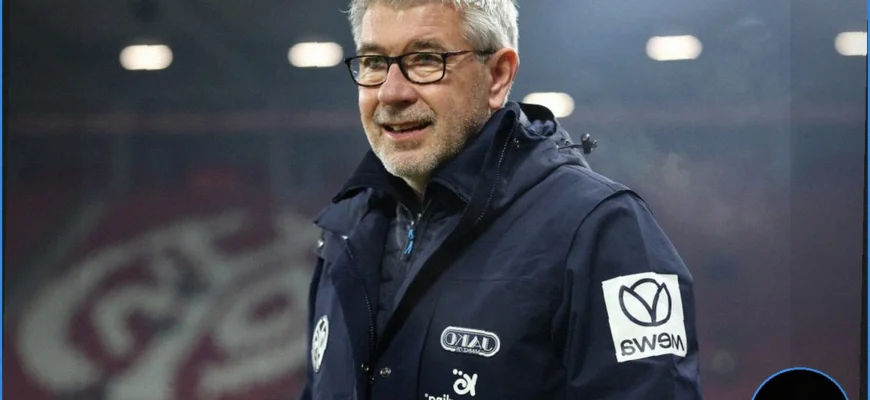
Mainz 05 head coach Urs Fischer recently shared insights into how he orchestrated a remarkable transformation, guiding his team from the bottom of the Bundesliga table to become a potential European contender. As a UEFA Conference League quarter-finalist, Mainz under Fischer’s leadership is not only thriving internationally but also surprisingly in contention for a European spot through their league performance next season.
Fischer took the helm in early December, succeeding Bo Henriksen, at a time when Mainz was languishing at the very bottom of the Bundesliga with just six points. After securing draws against formidable opponents like Bayern Munich and St. Pauli, bringing their pre-winter break total to eight points, his squad has since amassed an impressive 25 points in the 2026 calendar year. This incredible turnaround has propelled Mainz up to 9th position in the league standings.
Despite accumulating 33 points with six matchdays left, which seemingly positions Mainz safely away from Bundesliga relegation, the 60-year-old Fischer remains cautious. He refrained from echoing the confidence of Steffen Baumgart, coach of his former club Union Berlin, who felt his team would likely avoid relegation with 32 points from 28 games.
For Fischer, a single point more is not sufficient reason to declare safety. It’s important to note that this interview occurred prior to Mainz’s recent upset victory against Champions League hopefuls Hoffenheim. This latest triumph, adding to their impressive record of securing points against top teams such as Bayern, Bayer Leverkusen, RB Leipzig, and Eintracht Frankfurt since Fischer’s tenure began, further underscores their improved standing.
Urs Fischer: “We’re Still Fighting for Survival”
“I don’t consider my time here a success just yet,” Fischer stated firmly. “While the results might suggest success, we are undeniably still battling for survival. If analyses exclude Mainz from the list of teams in the relegation fight, I simply cannot comprehend it. This perspective doesn’t align with our team’s mindset, despite the notable improvement in our situation. We remain embroiled in the relegation struggle, and absolutely nothing has been achieved definitively.”
“It might sound like a cliché, but our approach is strictly one match at a time,” Fischer added. “We are simultaneously focused on ensuring our survival in the league and shifting our focus to achieve something significant on the international stage. We maintain a clear understanding of our own situation and deliberately distance ourselves from external evaluations.”
Fischer on His Initial Matches in Charge
“My initial focus was on refining minor details and establishing organizational stability on the pitch,” Fischer explained. “We successfully demonstrated this in our 1-1 draw against Lech Poznan. Subsequently, facing Bayern, a 2-2 draw felt more significant than a victory against a different opponent. Following this, we secured direct qualification for the Conference League round of 16 with a 2-0 win over Samsunspor.”
“A palpable sense of confidence began to emerge,” Fischer continued. “Nothing boosts morale and belief quite like positive results. Just before the winter break, our 0-0 draw against St. Pauli provided a crucial surge of confidence, allowing us to enter the brief Christmas hiatus on a high note. It’s always vital to conclude a period positively. Generally, our strategy was to avoid drastic changes.”
Fischer’s Perspective on Coaching Style and Modern Football
“In contemporary football, compactness and organization are paramount,” Fischer asserted. “The traditional, wide-open style of play is virtually obsolete. Every team now employs some form of compact and organized approach. The ‘smaller’ teams of yesteryear, which could be easily overlooked, no longer exist; they can pose significant challenges through their disciplined organization. Compactness, therefore, is an essential foundation for success.”
“Communication has become far more extensive these days,” Fischer observed. “This level of interaction was non-existent during my playing career. The coaching support staff has undergone a dramatic transformation. Previously, a coach might have an assistant, perhaps a goalkeeper coach, and a fitness coach. Now, a coach’s team includes multiple analysts, assistant coaches, athletic trainers, physios, a team manager, and many more specialists.”
“You encounter specialists in every conceivable domain, and it’s crucial to empower them to perform their duties, as that is their specialized area,” Fischer highlighted, further stressing: “Data serves as an supplementary tool. Full stop. Ultimately, it still comes down to my personal assessment of a player: does he possess the necessary qualities? Has he demonstrated them consistently? While data can be beneficial, one should never be exclusively driven by it.”