
In contemporary football, statistics have evolved beyond simple numerical counts, serving as powerful instruments for in-depth game analysis. Among these, Expected Goals (xG) stands out as a revolutionary metric, reshaping how analysts, coaches, and supporters evaluate offensive output. Distinct from conventional goal tallies, xG quantifies the quality of goal-scoring opportunities generated by a team or individual, thus offering a more comprehensive view of their performance. But what precisely goes into computing this crucial figure? We’ll delve into the primary components: distance from goal, shooting angle, shot type, and the degree of defensive pressure.
What is Expected Goals (xG)?
Fundamentally, xG quantifies the probability that any specific shot will culminate in a goal. Each shot is allocated a value ranging from 0 to 1, where 0 signifies an improbable outcome and 1 denotes a virtually certain goal. For instance, a penalty kick typically boasts an xG of approximately 0.76 to 0.80, underscoring its high scoring likelihood, whereas a speculative attempt from outside the penalty area might register an xG as low as 0.02. By aggregating a team’s xG over a single match or an entire season, analysts can discern whether they are consistently fashioning top-tier scoring opportunities or merely benefiting from fortuitous circumstances.
1. Distance from Goal
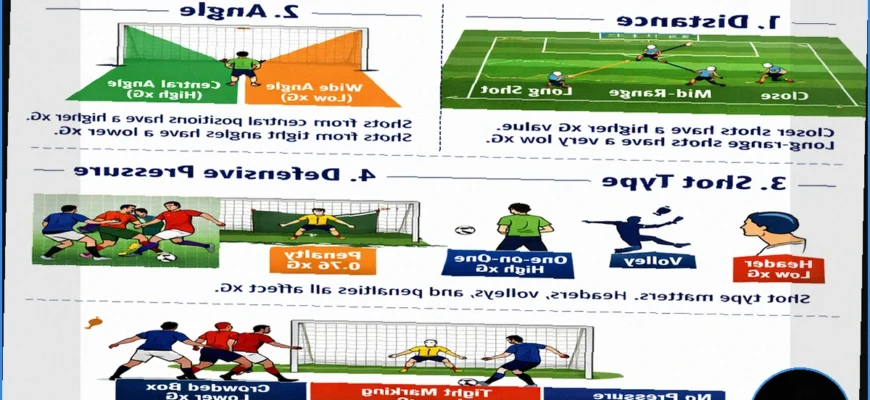
A paramount determinant in xG calculation is the distance of the shot. In essence, the nearer a player is to the target, the greater their statistical chance of scoring. Consequently, attempts originating within the six-yard box inherently possess a higher probability of becoming a goal compared to efforts launched from 25 or 30 yards away.
Sophisticated xG algorithms extend beyond a mere linear measurement of distance; they frequently integrate variables such as goalkeeper positioning and the angle of approach. For example, a shot from 12 yards out where the goalkeeper is out of position presents a significantly higher threat than an identical attempt with the keeper optimally placed. Distance remains a cornerstone variable across nearly all xG frameworks due to its direct correlation with scoring probability.
2. Angle to Goal
The angle from which a shot is taken constitutes another vital element. Shots struck from acute angles close to the goal line typically exhibit a lower scoring probability than more central attempts, even if the distance to goal is comparable. This phenomenon is attributed to a reduced visible goal area for the shooter, thereby increasing the goalkeeper’s likelihood of making a save.
Certain xG models further refine this by incorporating the concept of a shooting corridor, which simultaneously considers both the angle and distance. For example, a shot from 15 yards directly in front of goal will register a substantially higher xG than a 15-yard shot from an extreme wide angle near the touchline. By integrating the angle, analysts gain the capacity to distinguish between opportunities that might appear alike but possess vastly divergent success probabilities.
3. Shot Type
The nature of a shot plays a significant role, as not all attempts are equally potent. The specific shot type — be it a header, a volley, a simple tap-in, or a long-range strike — markedly impacts its assigned xG value.
- Headers typically possess a lower xG compared to shots taken with the feet, even when originating from close proximity, primarily because directing a header accurately is generally more challenging.
- Tap-ins executed directly in front of the goal often command an xG exceeding 0.7, indicative of their very high scoring probability.
- Long-range attempts register considerably lower xG values, frequently falling below 0.05, unless executed with extraordinary skill or catching the goalkeeper by surprise.
Furthermore, shot type also encompasses the player’s body orientation and control leading up to the strike, factors that can crucially affect the scoring opportunity. Modern tracking technologies can now ascertain whether a shot was taken with composure and control or while a player was in motion, thereby adding another layer of precision to xG computations.
4. Defensive Pressure
A vital, yet frequently underestimated, element in xG determination is defensive pressure. Even a shot from close quarters can become challenging if the shooter is closely guarded or under immediate duress from an adversary. Contemporary xG models incorporate considerations such as the sheer number of defenders present, the proximity of the closest defender, and whether the shooter faces a congested penalty area.
For instance, a shot taken from within the box where a defender is actively sliding to block it could see its xG plummet from 0.6 to 0.3. Conversely, an attempt made amidst a crowded box but with ample room for the shooter to maneuver might retain a higher xG. By integrating this defensive context, xG offers a more accurate representation of a chance’s genuine quality, moving beyond mere geographical location.
Additional Variables
Beyond the primary factors of distance, angle, shot type, and defensive pressure, some advanced xG frameworks integrate other contributing elements:
- Assist Type: Categorizing how the scoring opportunity was created (e.g., through ball, cross, corner kick, free-kick).
- Body Part: Specifying which part of the body was used to take the shot (right foot, left foot, or head).
- Game Situation: Differentiating between opportunities arising from open play versus those from set-piece scenarios.
- Match Context: Less frequently, factors like player fatigue or overall game tempo might be considered.
The inclusion of these supplementary variables facilitates a more refined and intricate assessment of chance quality, furnishing coaches and analysts with enhanced clarity regarding team and individual performance.
Why Expected Goals (xG) is Important
xG empowers teams to transcend a mere evaluation of the final score. A side might suffer a 2-1 defeat yet record an xG of 3.0, suggesting they generated sufficient high-caliber chances that, on average, should have resulted in a victory. Conversely, a team securing a 1-0 win with an xG of only 0.5 might be considered to have had a stroke of luck. Across an entire season, xG proves a more reliable predictor of performance trajectories than simply counting goals, assisting clubs in making informed strategic choices concerning tactics, player recruitment, and talent development.
Conclusion
Expected Goals has profoundly transformed football analytics, offering a data-driven methodology to quantify offensive quality. By meticulously incorporating variables such as distance from goal, shooting angle, shot type, and the intensity of defensive pressure, xG models distil intricate match scenarios into an accessible and meaningful numerical value. While not an infallible metric and best utilized in conjunction with other statistical measures, xG stands as an invaluable asset for managers, analysts, and supporters seeking to grasp the genuine underpinnings of goal-scoring opportunities.
With continuous advancements in tracking technology, xG models are progressively enhancing their sophistication, yielding deeper revelations into player effectiveness, team strategic approaches, and even potential targets for transfer. For anyone deeply invested in football analytics, comprehending the mechanisms behind xG calculation is foundational to fully appreciating the nuanced complexities of the sport.