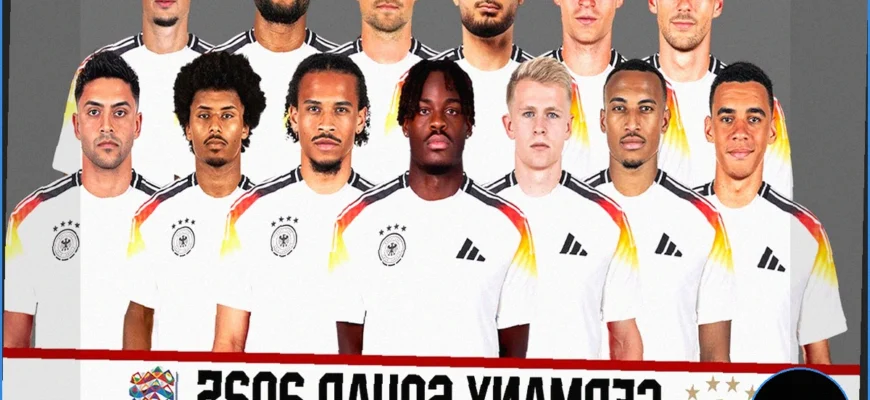
Germany has concluded its March 2026 international break, the penultimate preparatory phase before the upcoming summer World Cup. Julian Nagelsmann’s Nationalmannschaft secured victories in both friendly matches: a thrilling 4-3 away win against Switzerland in Basel on Friday and a 2-1 triumph over Ghana in Stuttgart on Wednesday.
Following tradition, a comprehensive report card has been compiled for all German players who featured prominently during these matches. Twenty footballers have been evaluated and graded in individual sections, presented in descending order of their performance ratings.
Out of the twenty players, six earned top-tier ‘A’ marks, distinguishing them as “winners” of the break. Conversely, four players received the lowest ‘D’ grades, categorized as “losers.” The remaining ten delivered average to satisfactory performances.
The “winners” group includes two Premier League players and four Bundesliga talents, with three of the latter hailing from Bayern Munich. In contrast, three-quarters of the “losers” are Stuttgart players, whose World Cup aspirations now appear to be in jeopardy or potentially over.
- Florian Wirtz, Liverpool
- Kai Havertz, Arsenal
- Serge Gnabry, FC Bayern München
- David Raum, RB Leipzig
- Leon Goretzka, FC Bayern München
- Lennart Karl, FC Bayern München
- Nathaniel Brown, Eintracht Frankfurt
- Jonathan Tah, FC Bayern München
- Antonio Rüdiger, Real Madrid
- Pascal Groß, Brighton & Hove Albion
- Joshua Kimmich, FC Bayern München
- Alexander Nübel, VfB Stuttgart
- Oliver Baumann, TSG 1899 Hoffenheim
- Leroy Sané, Galatasaray
- Deniz Undav, VfB Stuttgart
- Nick Woltemade, Newcastle United
- Nico Schlotterbeck, Borussia Dortmund
- Angelo Stiller, VfB Stuttgart
- Josha Vagnoman, VfB Stuttgart
- Chris Führich, VfB Stuttgart
Florian Wirtz, Liverpool
Matches played = 2/2, Matches started = 2/2
Minutes played = 151/180, Positions played = LW
Cumulative German Press Grade = 2,25
Author’s Cumulative Grade = A+
Florian Wirtz unequivocally emerged as the standout German player of this international window. His performance against Switzerland was nothing short of divine, directly contributing to all four of Germany’s goals with two masterfully scored goals and two exquisite assists. His contributions were pivotal, setting up Serge Gnabry and Jonathan Tah for their scores. While his impact naturally waned slightly in the subsequent match against Ghana, the 22-year-old still delivered a highly energetic display. In Stuttgart, he nearly created an early goal, hit the post from a free-kick, and initiated the move that led to the 1-0 penalty. Wirtz simply gave his all. Those who have followed Wirtz since his Bayern Leverkusen debut, shortly after his 17th birthday, note that he hasn’t displayed such vigor, fluidity, and agility in over a year. These two matches served as a powerful reminder of his generational talent. Liverpool supporters will undoubtedly hope he can replicate this form for his club, while German fans are currently more enthusiastic about Wirtz than any other player.
Kai Havertz, Arsenal
Matches played = 2/2, Matches started = 2/2
Minutes played = 109/180, Positions played = LS, RW
Cumulative German Press Grade = 2,75
Author’s Cumulative Grade = A
Kai Havertz, another Premier League player, delivered two commendable performances upon his return to the continent. As a former Leverkusen teammate of Wirtz and a fellow young debutant, Havertz led Nagelsmann’s 4-2-3-1 formation in the first match. Despite not being a natural lead striker, the 26-year-old excelled as a center forward, effectively utilizing space in the attacking third, consistently finding dangerous positions, and demonstrating excellent tactical awareness in linking up play. He registered three shots on target in the first game. In the second match, he surprisingly performed well playing on the right behind Nick Woltemade, taking two decent shots and being denied a clear goal-scoring chance by strong defending from Jonas Adjetey. After a brilliant opening 45 minutes, Havertz scored his first national team goal in 17 months from the penalty spot. Havertz appeared confident, showing no signs of a player regaining form after a long injury layoff. This might be partly due to Nagelsmann’s instruction before the second match, allowing him to exert himself fully before being rested at halftime. Regardless, Kai has made a compelling case for himself in two attacking roles ahead of the summer tournament, and ideally, he can carry this momentum into his club performances in the Premier League and Champions League.
Serge Gnabry, FC Bayern München
Matches played = 2/2, Matches started = 2/2
Minutes played = 135/180, Positions played = ATTM, AM
Cumulative German Press Grade = 3,0
Author’s Cumulative Grade = A
Serge Gnabry, often dubbed an “underrated player,” is experiencing a resurgence as both a No. 10 and a leader for the German national team. It’s remarkable to consider that Jamal Musiala’s injury in last summer’s Club World Cup might have been a catalyst for Gnabry’s lucrative Bayern contract extension and his current undisputed starting role as the attacking midfielder under Nagelsmann. This author has long advocated for Gnabry in a central supporting role, feeling that former Bundestrainer Jogi Löw misused him as a center forward. Gnabry delivered an excellent technical goal and a crucial assist in the victory against Switzerland. He maintained superb positional rotation throughout his 90 minutes, making Germany’s attacks and counters highly unpredictable. He was unfortunate not to score again when his shot was blocked by teammate Jonathan Tah. However, Gnabry appeared less incisive in the second match in his hometown of Stuttgart, missing a good opportunity and struggling with his touch at times. Similar to Havertz, Gnabry played only 45 minutes before his local supporters. It’s plausible that nerves affected his performance as he sought to impress his family and friends. This performance is overlooked here more leniently than by some German press outlets. Gnabry deserves recognition as he approaches what could be his final major tournament for Germany this summer, with this author openly hoping he carves his place in history.
David Raum, RB Leipzig
Matches played = 2/2, Matches started = 1/2
Minutes played = 119/180, Positions played = LB
Cumulative German Press Grade = 2,75
Author’s Cumulative Grade = A
David Raum, known for his prowess in delivering crosses, was instrumental in the first victory. Florian Wirtz’s disruptive play against the Swiss defense ahead of him significantly aided Raum’s effectiveness. He recorded two key assisted shots, one shot of his own, and six accurate crosses, ensuring he remained a focal point for observers. Defensively, he made several crucial tackles, often rescuing a vulnerable German backline. Enjoying his finest club season since joining RB Leipzig, Raum appears to have truly cemented his place with the national team. In the second match, Raum was substituted for Nathaniel Brown’s opportunity. Despite Brown’s decent showing, it’s unlikely he seriously challenged Raum’s starting position. Raum later entered the Ghana game for the final 29 minutes, maintaining an energetic and disciplined defensive presence while also contributing to a couple of attacking shots. A strong showing from the 27-year-old across both fixtures.
Leon Goretzka, FC Bayern München
Matches played = 2/2, Matches started = 1/2
Minutes played = 110/180, Positions played = CM, ATTM
Cumulative German Press Grade = 3,5
Author’s Cumulative Grade = A-
This author believes the German press was unduly harsh on Leon Goretzka, especially considering he played without his preferred midfield partner, Aleksandar Pavlovic, in the double pivot. Furthermore, his long-time partner Joshua Kimmich was deployed at right-back for Germany, which undoubtedly contributed to Goretzka’s struggles in defensive tracking and some uncharacteristically misplaced passes. Goretzka is fundamentally a box-to-box midfielder (No. 8), and this attacking inclination was evident as he amassed an impressive seven shots and four assisted shots across the two games. The uninspired displays from other midfield options (detailed later) likely strengthen Goretzka’s claim to a starting spot for Germany. The 31-year-old is far from declining; his attacking prowess appears to be at its peak in over two years, making him a valuable asset for any future club. He seamlessly integrated into the second half against Ghana, nearly assisting Lennart Karl late in the game.
Lennart Karl, FC Bayern München
Matches played = 1/2, Matches started = 0/2
Minutes played = 72/180, Positions played = RW, AM, ATTM
Cumulative German Press Grade = 2,75
Author’s Cumulative Grade = A-
Lennart Karl is indeed classified among the “A-Level Winners.” However, this author does not expect the highly praised teenage sensation to make the World Cup squad. Nagelsmann’s primary incentive to nominate the 18-year-old might be the prospect of his future physical development, as gaining height could potentially impact his exceptional dribbling, which relies on a low center of gravity. Nevertheless, Karl’s dribbling prowess was on full display with three impactful carries in the first match and two in the second. He contributed three assisted shots against Switzerland and took three shots himself against Ghana. The former Aschaffenburg talent was relentlessly effective on the right flank; in the second half of the second fixture, Serge Gnabry seemed to be drawing inspiration from his younger clubmate. Karl’s infectious play could yet earn him a World Cup spot, perhaps as a “super joker” for Nagelsmann in the States. Unlikely as it may seem, stranger things have occurred.
Nathaniel Brown, Eintracht Frankfurt
Matches played = 1/2, Matches started = 1/2
Minutes played = 61/180, Positions played = LB
Cumulative German Press Grade = 3,0
Author’s Cumulative Grade = B+
Entering the “B-Level” cohort, Nathaniel Brown, a Nuremberg native, made a commendable defensive impression, demonstrating careful selection in his passes. The German-American fullback, however, showed a slight reticence in forward link-up play, offering limited attacking presence. When he did venture forward, his passes tended to be grounded and central. As previously noted, he doesn’t yet pose a significant challenge to Raum’s starting position.
Jonathan Tah, FC Bayern München
Matches played = 2/2, Matches started = 2/2
Minutes played = 135/180, Positions played = CB
Cumulative German Press Grade = 3,0
Author’s Cumulative Grade = B
Jonathan Tah, often referred to as a “late bloomer,” delivered generally solid performances in both his appearances. His first national team goal against Switzerland, arguably, should have been credited to Gnabry. Defensively, Tah displayed some vulnerability in duels during the first match but redeemed himself against Ghana, winning all four of his ground and aerial contests. He also initiated several effective counterattacks and was unlucky not to score himself in the second game. His strong display against Ghana concluded at halftime when he was rested.
Antonio Rüdiger, Real Madrid
Matches played = 1/2, Matches started = 0/2
Minutes played = 45/180, Positions played = CB
Cumulative German Press Grade = 3,0
Author’s Cumulative Grade = B
It was a welcome sight to see Antonio Rüdiger return to the German national team, although his limited minutes made his presence almost forgettable in the second half against Ghana. The Berlin native was largely anonymous during his time on the pitch in Stuttgart, apart from one notable tackle. This is understandable given his return from a prolonged injury layoff. The 33-year-old could potentially reclaim a starting position, especially if Nico Schlotterbeck’s form continues to decline.
Pascal Groß, Brighton & Hove Albion
Matches played = 2/2, Matches started = 1/2
Minutes played = 70/180, Positions played = CM
Cumulative German Press Grade = 3,5
Author’s Cumulative Grade = B-
Pascal Groß, one of Nagelsmann’s more intriguing selections, performed commendably off the bench in the first match, notably assisting Florian Wirtz’s winning goal. In his start against Ghana, the 34-year-old adequately deputized for Leon Goretzka, although he lacked the attacking impact of the Bayern midfielder. This author was agreeably surprised by the Mannheim native’s effectiveness in the double pivot. However, expectations were modest, and it’s hard to imagine the veteran rediscovering significant pace for the demanding American summer.
Joshua Kimmich, FC Bayern München
Matches played = 2/2, Matches started = 2/2
Minutes played = 180/180, Positions played = RB
Cumulative German Press Grade = 2,75
Author’s Cumulative Grade = B-
Similar to his Bayern teammate Goretzka, this author believes Joshua Kimmich was unfairly assessed by the German press. Kimmich executed an excellent tackle in the first half against Switzerland but was otherwise largely ineffective, frequently drifting centrally from his right-back position. After having more time to adapt to his assigned national team role against Ghana, Kimmich was very engaged in the early part of the second match. However, his performance faltered once Nagelsmann moved him into midfield.
Alexander Nübel, VfB Stuttgart
Matches played = 1/2, Matches started = 1/2
Minutes played = 90/180, Positions played = GK
Cumulative German Press Grade = 3,0
Author’s Cumulative Grade = B-
There is little to extensively discuss regarding Alexander Nübel’s appearance in the second match. The VfB Stuttgart goalkeeper had a quiet game and wasn’t truly culpable for Ghana’s goal. No memorable saves were made, and Nübel showed little assertiveness in his distribution from the back. He, like Kimmich, delivered a respectable post-match interview, which might have slightly boosted his grade and potentially Kimmich’s as well.
Oliver Baumann, TSG 1899 Hoffenheim
Matches played = 1/2, Matches started = 1/2
Minutes played = 90/180, Positions played = GK
Cumulative German Press Grade = 3,0
Author’s Cumulative Grade = C+
Transitioning to the “C-Level,” let’s address both goalkeepers. Frankly, this author does not hold Oliver Baumann responsible for any of the three Swiss goals. However, the fact that Germany’s presumed starting goalkeeper for the World Cup only made one outstanding save does not instill strong confidence. Despite having only 11 senior caps at 33, there was a fair degree of assurance among Germans regarding Baumann as the tournament’s first-choice keeper. This confidence has now been somewhat shaken.
Leroy Sané, Galatasaray
Matches played = 2/2, Matches started = 1/2
Minutes played = 75/180, Positions played = RW
Cumulative German Press Grade = 4,5
Author’s Cumulative Grade = C
Addressing a potentially controversial evaluation, it’s important to acknowledge that Leroy Sané provided the assist for the game-winning goal against Ghana. Furthermore, his performance in the initial match was not entirely poor, though the 30-year-old struggled to assert himself consistently. Nagelsmann had given Sané another chance following his impactful display for the national team in November, and he showed sufficient commitment against Switzerland. A slight dip in form, however, might jeopardize his starting position. This author found his contributions to be adequate.
Deniz Undav, VfB Stuttgart
Matches played = 1/2, Matches started = 0/2
Minutes played = 45/180, Positions played = 3,0
Cumulative German Press Grade = 3,0
Author’s Cumulative Grade = C
Next, another contentious player. Nagelsmann accurately noted that, apart from the late winner orchestrated by Sané, Deniz Undav failed to make a significant impact. Nagelsmann reluctantly included the 29-year-old due to his impressive club form, making it difficult to deny him an opportunity. Beyond any potential “power dynamics” between Nagelsmann and Undav, a major factor in Undav’s limited national team presence is his tactical versatility, which, while a great asset for Stuttgart, can be a challenge for Germany. It will be interesting to observe how Undav’s national team prospects evolve.
Nick Woltemade, Newcastle United
Matches played = 2/2, Matches started = 1/2
Minutes played = 107/180, Positions played = LS
Cumulative German Press Grade = 3,5
Author’s Cumulative Grade = C
Julian Nagelsmann has consistently emphasized that Nick Woltemade was a provisional solution for Germany in the center-forward role. His tactical responsibilities at Newcastle United may have impeded his offensive contributions here. The 24-year-old’s attacking play in both matches lacked precision and opportune timing. However, when deployed deeper and in defensive roles, he executed several crucial interventions and blocks. Similar to his former Stuttgart teammate Undav, Woltemade’s tactical adaptability might hinder his ability to secure regular playing time for the national team.
Nico Schlotterbeck, Borussia Dortmund
Matches played = 2/2, Matches started = 2/2
Minutes played = 180/180, Positions played = CB
Cumulative German Press Grade = 4,5
Author’s Cumulative Grade = D+
Moving into the “D-Level Losers Cohort,” Nico Schlotterbeck struggled repeatedly defensively against Switzerland. Two of his first-half passing errors directly led to Swiss goals. Visibly shaken, Schlotterbeck’s performance remained erratic throughout the match, making Nagelsmann’s decision not to substitute him surprising. Despite playing the full 90 minutes against Ghana, the 26-year-old still appeared undisciplined in open play, though he did make contributions from set pieces. Whether attributed to his highly publicized and protracted contract negotiations, Schlotterbeck appeared unfocused throughout the international break. Borussia Dortmund also bears some responsibility for dismissing his preferred negotiating partner the previous weekend. This March break saw a surprisingly poor showing from a player previously thought to be on an upward trajectory, raising concerns about his starting position.
Angelo Stiller, VfB Stuttgart
Matches played = 2/2, Matches started = 2/2
Minutes played = 162/180, Positions played = CM
Cumulative German Press Grade = 3,75
Author’s Cumulative Grade = D+
Angelo Stiller unfortunately couldn’t capitalize on his late call-up, struggling to adapt to a more attacking role in Nagelsmann’s lineup. Partially hampered by Schlotterbeck’s errors in the first match, the 24-year-old found it difficult to perform defensively. To his credit, Stiller showed significant recovery against Switzerland, delivering some excellent threaded passes forward. The Munich native earned another chance against Ghana, but his performance offered little to convince Nagelsmann otherwise. Regrettably, following a promising early lob in the first five minutes, Stiller’s second appearance was marred by mistakes. While he did earn a handball penalty, Germany’s attack struggled to find rhythm, largely due to his inaccurate midfield passes. This opportunity, granted due to injuries to Felix Nmecha and Aleksandar Pavlovic, might not recur soon for Stiller, as building confidence so rapidly proved to be an overwhelming challenge.
Josha Vagnoman, VfB Stuttgart
Matches played = 1/2, Matches started = 0/2
Minutes played = 29/180, Positions played = RB
Cumulative German Press Grade = 5,5
Author’s Cumulative Grade = D
This international break was unequivocally poor for Stuttgart players, marking an end to any notion of Germany building its core around Stuttgart and Leverkusen talents. Josha Vagnoman was given an opportunity to prove himself as a right-back alternative to Joshua Kimmich. However, like Nnamdi Collins and Ridle Baku before him, Vagnoman’s performance reinforced Kimmich’s undeniable hold on the position. He was notably outmaneuvered by Derrick Köhn for Ghana’s equalizer in the second match, prompting direct criticism from Nagelsmann. His World Cup chances appear to be over.
Chris Führich, VfB Stuttgart
Matches played = 1/2, Matches started = 0/2
Minutes played = 29/180, Positions played = RB
Cumulative German Press Grade = 4,5
Author’s Cumulative Grade = D
To reiterate, this was a disappointing international break for Stuttgart players. Chris Führich, making his first national team appearance in two years at 28, will primarily be remembered for drawing a tactical foul from Schlotterbeck during his substitute appearance against Ghana. Führich, Vagnoman, Nübel, Stiller, and (pre-goal) Undav collectively struggled to make an impact before their home crowd. Anton Stach, despite playing only eight minutes against Switzerland, might now have a stronger claim to World Cup minutes than this quartet.