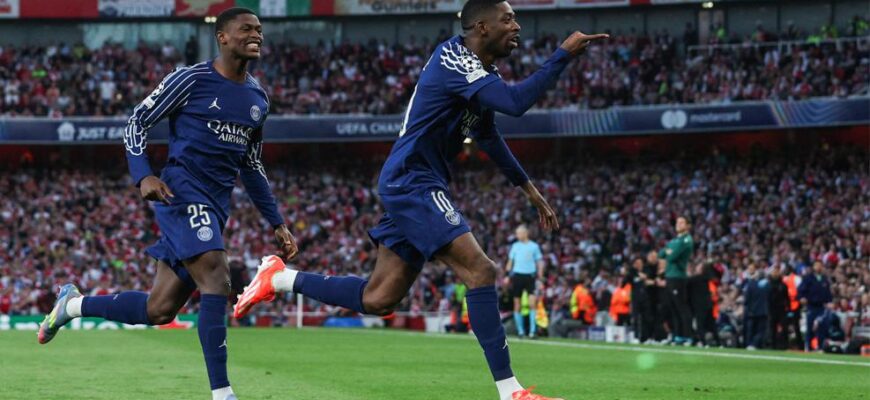
The delicate balance between club loyalties and national pride has once again been thrown into disarray, this time by Ousmane Dembélé`s latest injury while representing France. Reports indicate a palpable sense of anger emanating from Paris Saint-Germain (PSG), fueling the perennial debate on player welfare, differing medical assessments, and the significant investments clubs make in their star athletes.
The Incident: A Costly Acceleration
The flashpoint occurred during France`s recent 2-0 victory over Ukraine. Dembélé, having reportedly carried a pre-existing left thigh concern from a domestic fixture, was introduced into the match at halftime. Less than 35 minutes later, the dynamic winger was forced off the pitch, clutching his hamstring after an attempt to accelerate past the Ukrainian defense. This new injury, to what French national team manager Didier Deschamps described as the “other thigh,” swiftly ended Dembélé`s international stint.
Deschamps, in his post-match comments, defended the decision to play Dembélé, stating, “I was sure [that he could play], otherwise I wouldn’t have brought him on.” A manager`s confidence, however, often faces scrutiny when a player returns to his club injured, particularly under these circumstances.
PSG`s Unvarnished Anger: Warnings Allegedly Unheeded
Sources close to the Parisian club reveal that PSG is “furious” with the French national team`s handling of the situation. Crucially, it`s understood that PSG`s medical staff had reportedly communicated their concerns to their French national team counterparts, cautioning that Dembélé was not in optimal condition for competitive play even before the international break commenced. If these warnings were indeed issued and subsequently disregarded, it adds a layer of contention to an already sensitive situation.
For PSG, the financial and sporting implications are substantial. Having invested heavily in Dembélé, his repeated unavailability – especially from injuries sustained outside the club`s direct medical supervision – directly impacts their tactical planning, league performance, and Champions League ambitions. The frustration is not merely about a player being injured; it`s about the perceived lack of synergy and respect for the club`s medical assessments.
The Enduring “Club vs. Country” Conundrum
This incident is a textbook example of the “club vs. country” dilemma that regularly plagues professional football. Clubs pour immense resources into transfers, salaries, and advanced sports science, meticulously managing their players` workloads across demanding domestic and continental schedules. When players join their national teams, they enter a different environment with potentially varied medical protocols, training philosophies, and, critically, a different set of priorities focused on immediate international success.
The case of Ousmane Dembélé is particularly acute given his well-documented history of injury proneness. His career has been punctuated by numerous spells on the sidelines, making his physical management a paramount concern for any team. For PSG, integrating him effectively while mitigating injury risks is a continuous, high-stakes challenge. An injury sustained on international duty, particularly after alleged prior warnings, undermines this delicate management strategy and directly impacts the club`s return on its considerable investment.
Beyond the Immediate: A Call for Greater Synergy
While Dembélé awaits an MRI to ascertain the full severity of his latest injury, marking an almost certain end to his international break, this episode serves as a powerful reminder. It underscores the urgent need for enhanced, transparent communication and robust collaboration between club and national team medical departments. Both entities share a common goal: the well-being and peak performance of the player. Yet, their operational frameworks often remain distinct, leading to these inevitable clashes.
In modern football, where player value is at an all-time high, such disputes cannot be dismissed as mere unfortunate occurrences. They highlight a fundamental structural tension that, if not addressed through better dialogue and standardized protocols, will continue to generate “furious” reactions from clubs and potentially jeopardize the careers of key athletes. The future demands a more unified approach where national pride and club investment can coexist, rather than continually collide.