A Novel Concept in Football Officiating
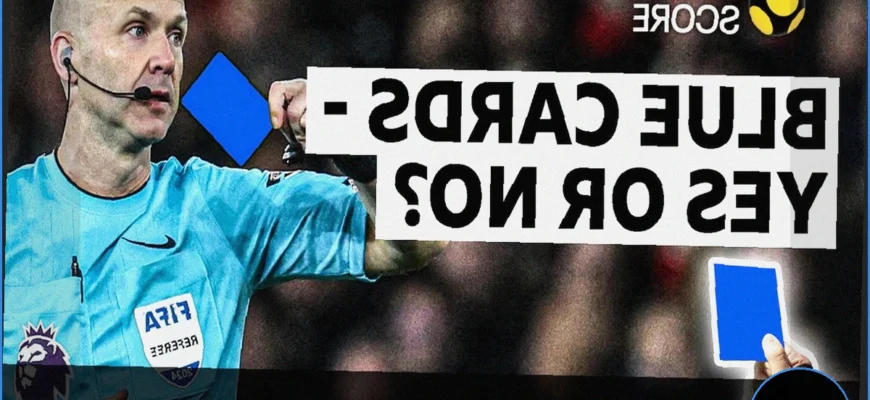
Football, a sport often resistant to fundamental rule alterations, is currently buzzing with discussion about the potential introduction of a “blue card.” This concept is straightforward: beyond the existing yellow and red cards, referees would have the power to show a blue card for specific infractions, leading to a temporary removal of a player from the field—akin to a “sin bin” in rugby.
Should this rule be adopted by the Premier League, it would mark one of the most substantial modifications to the sport in many years. The core question remains: would it truly enhance the game, or simply add unnecessary complexity?
Understanding the Blue Card’s Role
The proposed blue card would conceptually fit between a yellow caution and a red dismissal. Rather than a mere warning or a complete expulsion, a player would be sidelined for a defined duration—possibly 10 minutes—for transgressions like dissent, deliberate fouls designed to break up play, or thwarting promising attacking opportunities.
Such a temporary sanction seeks to resolve a persistent dilemma in football: certain fouls are too egregious for a yellow card but don’t quite warrant a red. The blue card is envisioned as a tool to bridge this gap, providing officials with greater discretion.
Nevertheless, incorporating a third type of card would profoundly reshape the management of matches, influencing both strategic decisions and player psychology.
The Arguments for Temporary Dismissals
Proponents of the blue card contend that it could significantly enhance player discipline and game fairness. A recurring source of frustration in contemporary football is the pervasive dissent from players—often seen surrounding officials, disputing calls, and trying to sway results.
A temporary removal from play could serve as a powerful deterrent. Even a brief period with a player down would compel teams to reconsider such conduct. Furthermore, it would strengthen referees’ authority, equipping them with a more precise instrument for game management without needing to deploy the most severe penalties.
Another benefit relates to addressing “professional fouls.” At present, players frequently incur a yellow card to halt dangerous counterattacks, understanding that the penalty is comparatively mild. A sin bin would dramatically increase the stakes for such tactical decisions, potentially re-establishing equilibrium between offensive and defensive strategies.
For fans, sin bins might also inject an extra layer of drama. A team temporarily playing with ten men generates inherent suspense, much like a power play in other sporting codes, potentially making games more fluid and less predictable.
Strategic Implications for Teams
Should the blue card be implemented, its influence on team tactics would be profound. Coaches would need to strategize for short-term numerical deficits, requiring immediate adjustments to formations and game plans.
For instance, a team might revert to a more defensive posture during a sin bin, focusing on containment until their player rejoins the action. Conversely, the opposing side could capitalize by launching aggressive attacks and exploiting the numerical advantage.
The significance of squad depth and player versatility would escalate, as individuals capable of fulfilling various roles would become crucial for navigating these transient imbalances.
Yet, this increased intricacy could also be perceived as a negative, especially for a sport that often champions its inherent simplicity.
The Counterarguments
Opponents of the blue card contend that football risks diluting its unique identity by incorporating concepts from other athletic codes. The straightforward nature of the existing system—yellow for a warning, red for an expulsion—is fundamental to football’s global appeal and accessibility.
Introducing an additional tier of punishment could sow confusion among players, supporters, and even the officials themselves. Inevitable questions would surface: precisely which infractions warrant a blue card? How reliably would referees apply it? Might it inadvertently generate more disputes instead of fewer?
Concerns also exist regarding the game’s intrinsic flow. Football is distinct for its largely uninterrupted play, and regular stoppages or pauses for sin bins could disrupt this essential rhythm.
Furthermore, the inherent subjectivity of refereeing is a factor. Officials’ decisions are already under intense scrutiny, particularly since the advent of VAR. A blue card would introduce yet another discretionary call, potentially escalating disagreements rather than mitigating them.
Impact on Participants and Spectators
For footballers, embracing a blue card system would necessitate a significant change in outlook. Self-discipline and emotional regulation would become paramount, given that even slight transgressions could lead to a temporary expulsion.
Fan reactions, conversely, are likely to be polarized. Some would appreciate the perceived increase in fairness and added dramatic tension, while others might view it as an undue layer of complexity. The Premier League, celebrated for its high intensity and swift tempo, might feel markedly altered with players frequently exiting and re-entering play.
An additional point of concern is the lack of uniformity across different competitions. If the Premier League were to implement blue cards while other leagues refrained, it could foster considerable confusion, especially during international competitions.
A Progressive Step or a Bridge Too Far?
Ultimately, the concept of a blue card revolves around striking a balance—locating a compromise between overly lenient and excessively harsh penalties. Theoretically, it presents a potential remedy for several recurring problems in football, spanning from player dissent to deliberate tactical fouls.
However, football’s enduring appeal has always been rooted in its fundamental simplicity. Any alteration of such significant scope demands meticulous deliberation, as it carries the inherent risk of fundamentally changing the sport’s very nature.
Concluding Thoughts
The adoption of a blue card in the Premier League would undeniably ignite controversy, yet it also presents an avenue for modernizing the sport. Its success as a beneficial innovation or its descent into superfluous complexity hinges entirely on its precise implementation—and the collective willingness of players, officials, and supporters to accept such a significant transformation.
Presently, the discussion persists. However, one truth remains clear: the very proposition of a blue card signifies that football, despite its deep-seated traditions, remains in a state of continuous evolution.